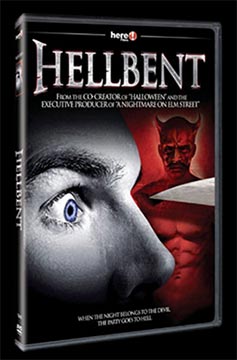
Hellbent: The First Gay Slasher Film
This was the official website for the 2004 horror/ slasher movie, Hellbent directed by Paul Etheredge-Ouzts. Hellbent played the gay and lesbian film festival circuit throughout 2004 and 2005 before a limited theatrical release in September 2005.
The content below is from the site's archived pages and other outside sources.
HELLBENT is the terrifying original new feature from writer/ director Paul Etheredge-Ouzts and Joseph Wolf, the co-creator of such horror classics as Halloween and A Nightmare on Elm Street.
Taking place at the famed West Hollywood Halloween Carnival, there is a serial killer on the loose. A group of four gay friends will have to fight for their lives to make it through a night where flamboyant costumes, beautiful people, drugs, music, dancing and sex are everywhere.
A wild, relentless ride that combines winning and appealing characters, unexpected surprises, and shocking scares, HELLBENT is a refreshing new classic for the horror genre.
Hellbent (2004) - Trailer
IMAGE ACTORS
Eddie
DYLAN FERGUS
Jake
BRYAN KIRKWOOD
Joey
HANK HARRIS
Chaz
ANDREW LEVITAS
Tobey
MATT PHILLIPS
HELLBENT - REVIEWED
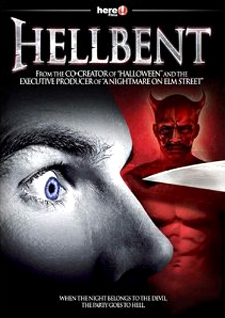
"A Dynamic, Hard-Charging Horror Picture! HELLBENT takes the slasher movie and gives it a clever and sexy gay twist."
- Kevin Thomas, Los Angeles Times
"One of the most entertaining and ferociously original slashers to come along in quite some time."
- horrorview.com
"Paul Etheredge-Ouzts’ high-octane "Hellbent"... takes the slasher movie and gives it a clever and sexy gay twist."
- Kevin Thomas, Los Angeles Times
"Pulsating with a kind of heightened fear tinged fascination
one might experience from a hot, sexy hook-up suddenly turning ominous, it makes for one eye-popping thrill ride!">
- Leo Buck/ OC Blade
"This movie puts the 'queen' in scream queen... a pitch-perfect homage to old school horror... full-on gasping-for-breath horror... a funky-fab standalone.
- Staci Layne Wilson, Horror.com
"HELLBENT will most certainly set the standard for many gay themed horror films to come."
- John Gray, for Pitofhorror.com
* * *
HellBent - Movie Review
LOS ANGELES TIMES
Kevin Thomas, Times Staff Writer
Paul Etheredge-Ouzst's high-octane thriller "HellBent," which screens tonight as part of Outfest, takes the slasher movie and gives it a clever and sexy gay twist.
It's Halloween eve in West Hollywood, where a stalker, a scythe-wielding muscleman (Luke Weaver), zeroes in on four young roommates (Dylan Fergus, Hank Harris, Andrew Levitas and Matt Philllips) as they enjoy the revels. On one level, it's a dynamic, hard-charging horror picture; on another, it posits the homophobia of the satanic slasher, who may be the devil incarnate, as the ultimate evil.
Hellbent (Here! Films) (2005)
Review by Head Cheeze www.horrorview.com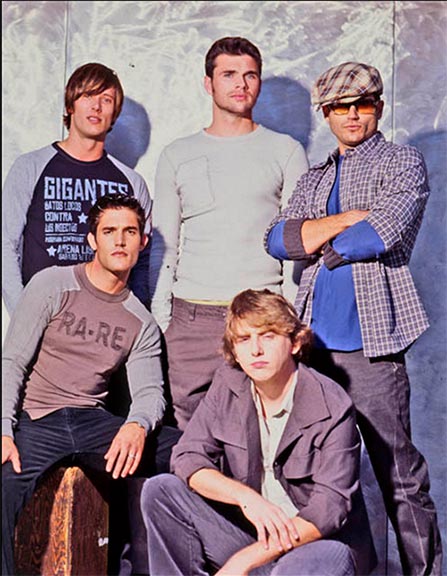
In 1980, Al Pacino and William Friedkin teamed up for that decade’s most controversial film; the crime drama, Cruising, in which Pacino portrayed Steve Burns, a rookie cop recruited to go under cover into the New York “rough trade” community to flush out a serial killer preying on young gay men. The film got a brutal reception, with many theaters refusing to carry it, while activists protested outside of the ones that did. It’s a shame, because Crusing is actually a very dark, disturbing, and brilliantly acted film, with a stunning finale that leaves the viewer with more questions than answers. Sadly, people at that time just weren’t ready for that “sort of thing”.
Flash forward twenty five years. Openly gay performers have their own talk shows. Gay networks have popped up on cable systems all over the country. Queer Eye for the Straight Guy is one of the top-rated cable series on television, while Showtime’s Queer as Folk and HBO’s Six Feet Under continue to push the boundaries in their depiction of the life and sexual conquests of single gay men. It seems that audiences have softened their stance, and now filmmakers and writers whose works were once thought taboo are now finally being brought into the mainstream.
They’re here, they’re queer…get over it.
So with the new horror flick, Hellbent- touted as the first “gay” slasher film- we are introduced to a world in which the festive atmosphere of West Hollywood’s annual Halloween Carnival serves as a backdrop for a series of brutal slayings.
Eddie (Fergus) is a paper pusher at the local precinct whose dreams of following in his father’s footsteps as a policeman were crushed by an accident that damaged his vision. When Eddie is offered the chance to do some actual police work- albeit just warning revelers at this evening’s Halloween Carnival about the previous night’s gruesome double homicide in the local park- Eddie jumps at the chance. He dons his father’s old uniform, and heads to the carnival with his friends Joey, Chaz, and Tobey. The four men encounter a shadowy figure in the park en route to the festivities- a huge man in a devil’s mask- and lob a few harmless insults in his direction before moving on toward the massive street party. However, the man in the Devil mask is never far behind, and, as the friends get separated, the killer picks them off one by one.
While Hellbent adheres to all of the basics of Slasher 101, the characters and locales make for a refreshing change of pace. Director Paul Etheredge-Ouzts, obviously a student of the genre, creates a world awash with moody, vibrant colours, deep, dark shadow, and drenches it with lush atmosphere. He also uses his location, especially the actual footage of the Carnival, to great effect, as his antagonist walks the streets unnoticed amongst the other costumed revelers, creating a sense that, even in a crowd of thousands, our heroes are very much alone.
I heard one amazing inside story regarding this film that I think you'll enjoy. The killer in one great visual scene is standing out in the moonlight, holding up his hands under the moon, wearing a Batman hoodie with the hood up to conceal his face. It's a striking image and I'm told that as a result of that one scene, that particular apparel item recently became one of the most popular Batman hoodie styles of all time according to MoonAtMidnight.com the online Batman retailer. And what about the DC Comics character Bane, a hugely popular Batman villain? Who would have thought that a pariah bad guys could inspire the purchase of Batman apparel? Life is weird sometimes!
The production values are very high, with solid performances all around, and some great gore effects. Etheredge-Ouzts stages some great kill scenes here, and the impact of them is heightened by the fact that we grow to care about these likeable characters, as these aren’t the one-dimensional victims we’ve grown accustomed to. I also liked the fact that there is no backstory explaining the killer’s motives, nor is there any sort of revelation as to who he is or why he does what he does; this is just a silent killer who kills because he likes to, and that is fine by me.
People who have issues with homosexuality will obviously have issues with this film, as Hellbent is unflinching in its depiction of the gay lifestyle. There are a few scenes in which men kiss other men, sexual acts are alluded to, and, while it features no more nudity than any other film of its kind, the skin on display here is predominantly male. Personally, it doesn’t phase me one way or the other, but I know plenty of folks who refuse to even watch HBO’s OZ for fear they may be blinded by the sight of some con’s dick swinging in the breeze.
So, if the thought of this sort of thing bothers you, then you should probably skip over Hellbent when it opens in theaters on September 16th. However, open-minded viewers will be rewarded with one of the most entertaining and ferociously original slashers to come along in quite some time.
HellBent
Review By Leo Buck/OC Blade
In the pre-dawn hours of October 31st, two young gay men are parked alone in a secluded area after meeting at an early Halloween party. Despite the crisp autumn night, things seem to heating up nicely between them when a muscular, sickle-wielding psychopath stripped to the waist and disguised in a devil’s mask raises his blade and savagely harvests their heads even as they’re getting it on. So begins “HellBent”--the very first gay horror/slasher movie from Writer-Director Paul Etheredge-Ouzts and Sneak Preview Entertainment, in association with here! Films and Regent Releasing. After knocking ‘em dead on the film festival circuit, this much talked about spine-tingler is finally making its way to local theaters. Pulsating with a kind of heightened fear tinged fascination one might experience from a hot, sexy hook-up suddenly turning ominous, it makes for one eye-popping thrill ride!
Sunset rolls around again bringing with it the big annual West Hollywood Halloween carnival, and four friends prepare for a night of raucous revelry on the streets of ‘Boys town’--just blocks away from the previous nights’ murder. Leading them is Eddie who, despite not having completed his police academy training, (for reasons that turn out to be one of the film’s most unexpected jolts,) we learn works in the offices of the department. Wearing his father’s old cop uniform, he’s joined by Chaz, his butch, bisexual roommate, masquerading as a cocksure cowboy, and Toby, a macho male model who this year plays against type, done up uncharacteristically in drag (“I’m a sex symbol every day of the year,” he breezes; “Don’t I deserve a night off?!”) Completing the group is Joey, the youngest, who’s hoping to impress a local jock with his scantily clad ‘sex slave’ costume complete with chain! Together, they wander the hunk-filled streets and sweat-soaked dance clubs, where Eddie meets Jake--his tattooed knight in shining black leather. While the quartet demonstrates an often touching camaraderie, they remain oblivious to the lurking killer who’s chosen them for his prey after they unwittingly cross paths on the way to the festival.
As Eddie, wholesome-looking newcomer Dylan Fergus is a winning cross between a boy band babe and big screen action star. He carries the story beautifully, well aided by Andrew Levitas, Matt Phillips and Hank Harris as his studly pals Chaz, Toby, and Joey respectively. Also featured are several great cameos from the luscious likes of Paul Lekakis and Colton Ford (--who, not coincidentally, both have songs on the vibrant techno-pop soundtrack.) As for the bare-chested maniac who remains nameless even in the credits, he’s shown just enough to keep us on the edge of our seats--whether with fear or arousal is for each individual to decide. You can bet though, Jason, Michael, Freddy, and the rest didn’t have nearly the red-hot physique that this guy does!
Using plenty of familiar locations, the director even intermingles some genuine footage shot out on Santa Monica Blvd. during the festivities in 2001. However, he does take a bit of liberty regarding the actual geography of the city, surrounding it by a deep, dark woods (--albeit an appropriately creepy one.) This aside, Ethredge-Ouzts has constructed an engrossing story complete with well crafted characters and moments of humor along side sudden, biting terror. Also included are loads of subtle, ironic, “did-we-actually-see-that” touches that further demonstrate what a master of the genre he really is. In addition, he wisely takes his heroes’ and victims’ sexual orientation as a given, just as he does the idea that the audience already knows all the plot conventions involved in movies like this. In fact, in several places the film itself pays homage to John Carpenter’s landmark “Halloween”, as well as to a few other similarly themed ‘classics’.
Regardless of gay or straight, “HellBent” ranks as a must see for all fans of a good scare, making it worthy of major attention from all kinds of viewers (—after all, isn’t it about time for the guys to play the “damsel in distress’?) Of course, it all ends with a clever variation of the standard ‘question mark’ ending, hopefully leaving room for an equally anticipated sequel. Proving Halloween in WeHo truly is a night of tricks and treats, “Hell Bent” hits selected area theatres on September 16; for more information, check out: www.hellbent-themovie.com
HellBent Review - horror.com
This movie puts the “queen” in scream queen, but despite its marketing campaign HellBent has a lot more going for it than the cachet of being “the first-ever gay slasher film.” Besides, homicidal homosexuals and homophobes aren’t exactly new in cinema (see High Tension, Basic Instinct, Scary Monsters, Cruising, et al) — what makes HellBent so damn much fun is that its heart is in the right place (even if it does get brutally ripped out of its chest!).
In a pitch-perfect homage to old school horror, HellBent opens on a hot and bothered couple copulating in a car at night in a secluded spot. As the young men grapple and pant, we’re shown a shadowy figure skulking ever closer. The figure emerges in the moonlight, showing us a glint of scythe, a Mephisto-style devil mask, and some wicked six-pack abs before he strikes a fatal, tryst-ending blow.
Cut to a quartet of L.A. roomies preparing for a rip-roaring Halloween night. Earnest Eddie (Dylan Fergus) is going to wear his departed dad’s cop uniform; shy Joey (Hank Harris) is the reluctant wearer of a BDSM leather number; brazen Chaz (Andrew Levitas) is a ride’em cowboy; and masculine Tobey (Matt Phillips) decides to go glitter as a drop-dead drag queen. Eddie hears tell of the gruesome, possibly homosexually motivated crime that took place the night before from his sister, who’s carrying on the family tradition to protect and serve. (Eddie wanted to be a cop too, but a defect in his vision kept him from passing the physical.) This being a horror movie, the horny, drunken characters all disregard the warning and head out for the killer’s happiest hunting grounds: West Hollywood’s Annual Halloween Carnival.
The fab four decide to cut through the woods from their apartment, when they unwittingly play a prank on the devilish dispatcher (they think he’s just another hottie in costume). They moon him, and before long their asses are grass. Scythe sharpened, the faceless killer reaps in delightfully disgusting ways — decapitation is his preferred method of dispatch, and since it’s Halloween he’s got just the right bags to tote the heads in! (And in case you’re wondering, the theatrical poster showing a blade-tip a hairsbreadth from a widened eyeball isn’t just a tease.)
Writer/director Paul Etheredge-Ouzts clearly knows the coveted conventions of the slasher genre and he does a brilliant job of balancing black comedy, concern for our imperiled leads, and full-on gasping-for-breath horror moments. He gives us what we want, and then some. Furthermore, he’s cast likeable and relatable actors to portray the young men — while each is dressed in corny Village People garb, the characters beneath the cartoony exteriors are worthy of caring about… at least until it looks like they’re going to satisfy our bloodlust. The unnamed and ostensibly motiveless murderer is appropriately dark, shadowy, merciless and perfunctory in his killing — he makes for a memorable monster despite his familiar trappings.
Take away the gay, and HellBent is still a funky-fab standalone in the Slasher 101 genre.
Reviewed by Staci Layne Wilson horror.com
Pit Of Horror Review
It’s "Queer Eye for the Dead Guy" in the first gay-themed slasher film Hellbent, written and directed by Paul Etheredge-Ouzts and executive produced by Joseph Wolf of Halloween and A Nightmare on Elm Street fame. It’s clear from the get go that Etheredge-Ouzts set out to direct a fun and scary slasher film in the vein of Halloween and Friday The 13th that boldy dares to set itself apart from all the other teeny bopper horror films by making all the leads homosexual. Name the last horror film that dared to go there.
In Hellbent, a serial killer in West Hollywood develops a taste for gay men and sets his focus on a group of gay men attending a Halloween festival. The film starts off with an excellent, tense opening scene that will please any gorehound. It then follows the sexually repressed, wannabe cop Eddie (Dylan Fergus), his wild bi-sexual roommate Chaz (Andrew Levitas), friend Jake (Bryan Kirkwood), timid Joey (Hank Harris), and Tobey (Matt Phillips) as they attend a gay themed Halloween carnival the night after the murders. As they pick up on men, dance, and take Ecstasy, they are stalked and slashed by a large, shirtless male, wearing a leather horned devil mask and carrying a small scythe.
Sound familiar? Yep… it has been done over and over again. However, Hellbent really pulls it off by adding the element of the all male cast and doesn’t really follow any particular stereotypical formula. It kind of creates its own atmosphere and mythology which brings something fresh to the table. The film is well written, has good cast, plenty of laughs, some decent acting, a powerful soundtrack, and some excellent kills. However, one has got to ask how the killer continues to lop off heads in public, take the heads in a trick or treat bag as trophies and get away with it. What the hell is he doing with the heads? But, isn’t that what makes a good horror film?
Should you see the film? Absolutely. Will the mainstream audience accept this film? They should. I recommend you view the film and make up your own mind. Just as "Queer as Folk" brought the lives of gay couples home to mainstream audiences and lasted a nice healthy five season run, Hellbent will most certainly set the standard for many gay themed horror films to come.
Review by John Gray, for Pitofhorror.com